
Share This On


3D Printing Plastic Market – Size, Outlook, Trends and Forecast (2024 – 2032)
Report ID
#5356
Report Type
Global
Study Period
2018 - 2035
Base Year
2025
Expected CAGR
7%
3D Printing is the process of making three dimensional solid objects from a digital file. This is a technology that uses a printer to manufacture the printed product and a digital life to produce objects. It is used in rapid prototyping as well as in final products. Polylactic acid (PLA), Acrylonitrile butadiene styrene (ABS), polyvinyl alcohol plastic (PVA) are the major types of plastics in 3D Printing.
Global 3D Printing Plastic Market Size & Growth:
Global 3D Printing Plastic Market size is projected to reach 823.2 Million by the end of 2024 with a CAGR of 34.9% during the forecast period. Key Parameters promoting the market growth include entry of large players from polymer industry and availability of wide range of grades as per different applications, growing awareness of the ability to manufacture objects using varied plastic materials, fast-growing technological industries, estimated rise in supply capacity with forward integration, development in application based definite results, proficient for bulk manufacturing within less time period, development of application-specific grades, and highly potential market with government support. The most commonly used 3D Printing materials in the market are plastic and photopolymer 3D Printing materials. These materials are reliable compared to the metals and also cheap, which is the reason behind their growing popularity.
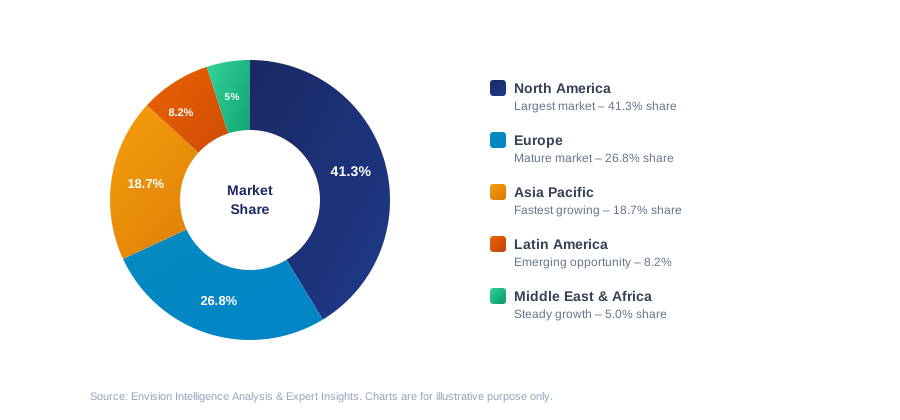
Global 3D Printing Plastic Market Share:
3D Printing Plastic Market
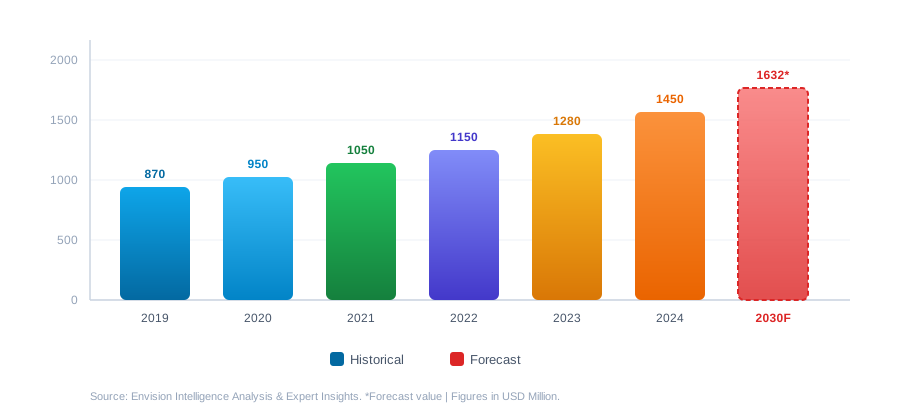
Expected CAGR
~7.6%
2026-2035
Global 3D Printing Plastic Market is classified by Type, by Form, by Application, by End-User, by geography. By Type, the Global 3D Printing Plastic Market is classified as photopolymers, ABS, polyamide/nylon. ABS is witnessed to grow at a high rate during the forecast period owing to increasing demand of ABS filament in FDM or FFM technology due to its mechanical properties over other general grades such as PLA and nylon used in FDM, and it is mostly used in commercial applications. Based on Form, these are classified as Filament, Ink, and powder. Based on Application, these are classified as Commercial/ Industrial, Hobbyist. By End-User, these are classified as healthcare & medical, defence & aerospace, consumer goods, and automotive. Healthcare & defence segments are dominating the 3D printing plastic market. These segments will demand stringent product dimensions along with their compositions. Extensive consumption of plastic materials comes from aerospace and automotive domains owing to changing product designs from time to time.
North America is a global leader, and it is expected to have the highest growth due to the increasing rate of adoption in the automotive industry.
Europe is witnessed to have the market growth during the forecast period 2018-2024. The European region has an advantage of having most of the manufacturing and consumption markets, thus providing the maximum contribution to the 3D printing plastic market. Europe followed by Asia-Pacific are the market leaders in the 3D printing plastics and these regions have a large number of suppliers of 3D printing plastics in countries like India, Germany, U.K., France, Italy, and others.
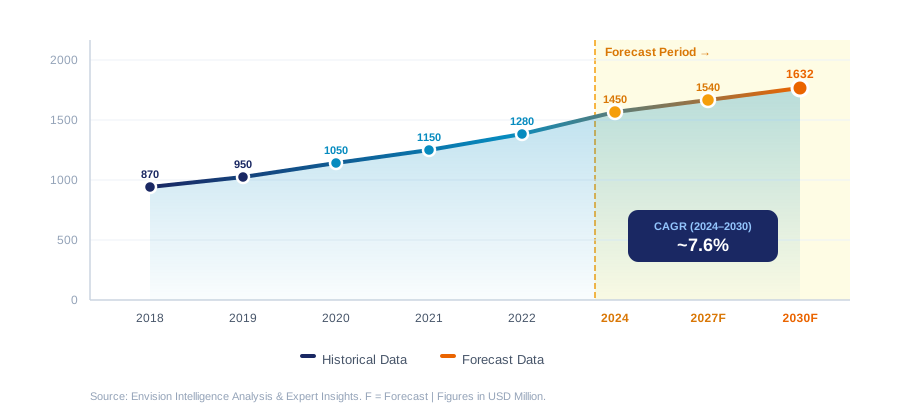
Global 3D Printing Plastic Market Trends:
3D Printing Plastic Market
Global 3D Printing Plastic Market Research Reports:
3D Printing Plastic Market
Market Size Available | 2018 - 2035 |
Base Year | 2025 |
Forecast Period | 2026-2035 |
Historical Period | 2018-2025 |
Segments Analysed | By Type, Application, and Region |
Analyses Covered | Global, Regional & Country Level; Segment Analysis; Drivers, Restraints, Opportunities, Challenges; PESTLE; Porter's Five Forces; Competitive Landscape |
Regions Covered | North America · Europe · Asia Pacific · Latin America · Middle East & Africa |
Report Formats | Extensive Report (350 pages) | Snapshot Report (85 pages) |








Starting from $2700

Starting from $2160

Starting from $2700
Keep up-to-date with our weekly newsletter, Media Pulse.

Data-driven market insights & solutions


