
Share This On


North America GPS Tracking Devices Market – Size, Outlook, Trends and Forecast (2024 – 2032)
Report ID
#6572
Report Type
Regional
Study Period
2018 - 2035
Base Year
2025
Expected CAGR
7%
GPS tracking is the surveillance of location by using a global positioning system to detect or track the location of a person or vehicle remotely. GPS equipment is widely used in science, and now it is more popular and has become sufficiently low cost. GPS tracking devices will work in different ways such as they are used to record the position of vehicles, storing the data, a sending the data within the GPS tracking systems itself.
North America GPS Tracking Devices Market Size & Growth:
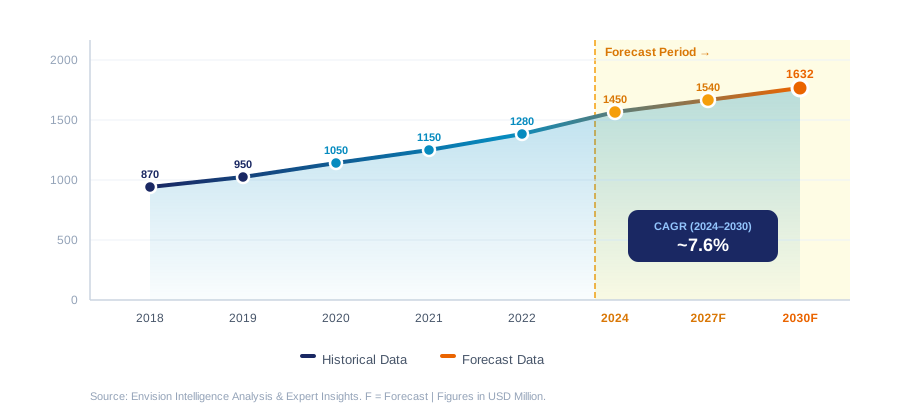
The North America GPS tracking devices market was valued at $XX Billion in 2017 and is estimated to reach $XX Billion by 2024, at a CAGR of XX% during the forecast period. High accuracy, longer life, high ROI (Return on Investments), growing concern about safety and security, and high adoption rate of advanced technologies are leading the GPS tracking devices market growth in North America. Additionally, the momentum given to security systems and better management of resources and increasing sales of commercial vehicles will play a significant role in promoting the market growth during the forecast period. IoT and cloud technology and the advent of cellular technology are also leading the market growth. However, the impact of nonstandard products and several environmental factors are the significant restraints hampering the market growth. Advancements in technology and software are creating profitable opportunities for the North America GPS tracking devices market during 2019-2025.
North America GPS Tracking Devices Market Segments Share:
The North America GPS tracking devices market is segregated based on type, deployment type, component, tracking device, end user, and geography. By type, the North America GPS tracking devices market is classified into the standalone tracker, advance tracker, and OBD (On Board Devices). Among these, advanced GPS tracker is estimated to hold the most significant market share in the overall North America GPS tracking devices market owing to declining prices and growth of commercial fleet management. Advanced trackers capture the valuable information related to vehicle performance, and thus the adoption rate of these types of trackers is high compared to others. By deployment type, the market is segregated into the commercial vehicle, cargo and container, and others. Commercial vehicle deployment type is expected to hold the most significant market share and is estimated to witness the highest CAGR due to increased sales and high usage of GPS tracking devices in commercial vehicles.
By component, the market is classified into GPS loggers, personal GPS trackers, and real-time GPS trackers. The advent of cellular technology reduce the service cost, and the declination in prices provides the scale of economies to GPS module suppliers. By tracking devices, the market is segmented into satellite and cellular. Among these, the cellular segment is expected to witness the highest CAGR and satellite segment is estimated to show the significant market growth owing to the rapid proliferation of mobile devices and high tracking accuracy.
North America GPS Tracking Devices Market
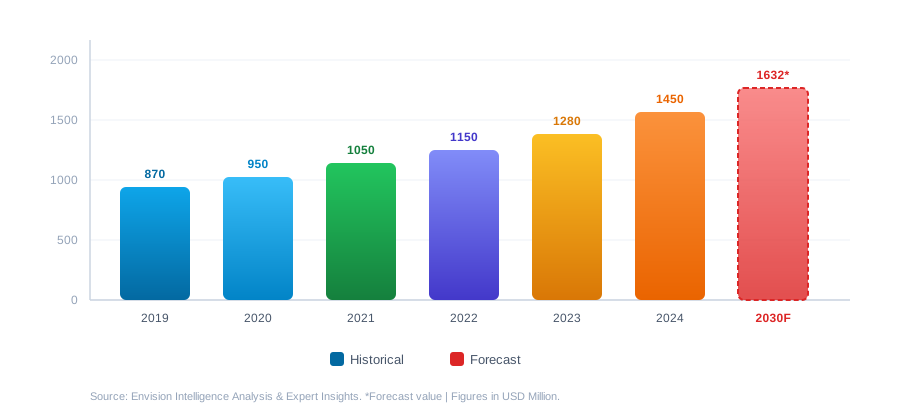
Expected CAGR
~7.6%
2026-2035
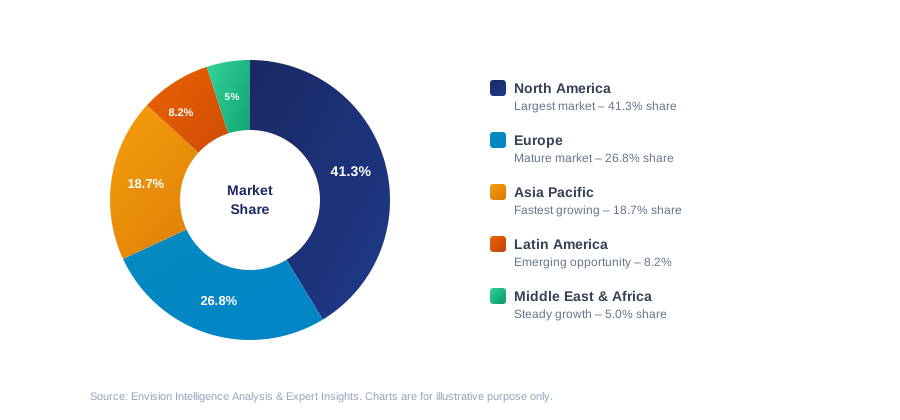
By end user, the market is divided into transportation & logistics, automotive and aerospace, oil & gas, and others. Transportation & logistics segment holds the significant market share is owing to the high adoption rate of GPS tracking devices and long life. By geography, North America region is segregated into U.S., Canada, and Mexico. Among these, especially U.S. shows the promising market growth and plays a vital role in GPS tracking devices market. Governments are focusing on launching more satellites to deliver better performance of GPS trackers and to improve the accuracy of navigation.
North America GPS Tracking Devices Market Trends:
North America GPS Tracking Devices Market Research Report:
An executive summary condensing the whole report such that essential authority can rapidly twist up doubtlessly acquainted with brief overview and conclusion.
To have a complete market analysis, industry value chain analysis, Porter’s Five Force Analysis, PESTLE, SWOT analysis, and Y-o-Y analysis were carried out to understand the market more comprehensively.
North America GPS Tracking Devices Market
Regional and Global Diversity is analysed with the major countries and the unions. Scrutinizing the revenue generation on Year-On-Year
Identifying DROC in the current market and their impact on altering market dynamics.
Competitive landscape analysis to identify the mergers and acquisitions which will have a comparative financial analysis with significant competitors.
Expertise investment opportunities by an analyst to the individual and organisation to have a better foothold in the market.
The primary critical players in the North America GPS Tracking Devices Market are:
Along with these companies, there were many other companies considered/ cited in the report while analysing the North America GPS tracking devices market. These companies hold substantial share-owning to the nature of the industry whereas the rest of the market shares are marginal chunks to regional and local level manufacturers. Other players have considerable presence owing to its robust brand image, geographical reach and stable customer base.
North America GPS Tracking Devices Market
Market Size Available | 2018 - 2035 |
Base Year | 2025 |
Forecast Period | 2026-2035 |
Historical Period | 2018-2025 |
Segments Analysed | By Type, Application, and Region |
Analyses Covered | Global, Regional & Country Level; Segment Analysis; Drivers, Restraints, Opportunities, Challenges; PESTLE; Porter's Five Forces; Competitive Landscape |
Regions Covered | North America · Europe · Asia Pacific · Latin America · Middle East & Africa |
Report Formats | Extensive Report (350 pages) | Snapshot Report (85 pages) |








Starting from $2700

Starting from $2160

Starting from $2700
Keep up-to-date with our weekly newsletter, Media Pulse.

Data-driven market insights & solutions


